Investor Regret: Why You Hold Losing Investments and the System for Making Better Decisions
January 9, 2024 · Joshua Fincklstein
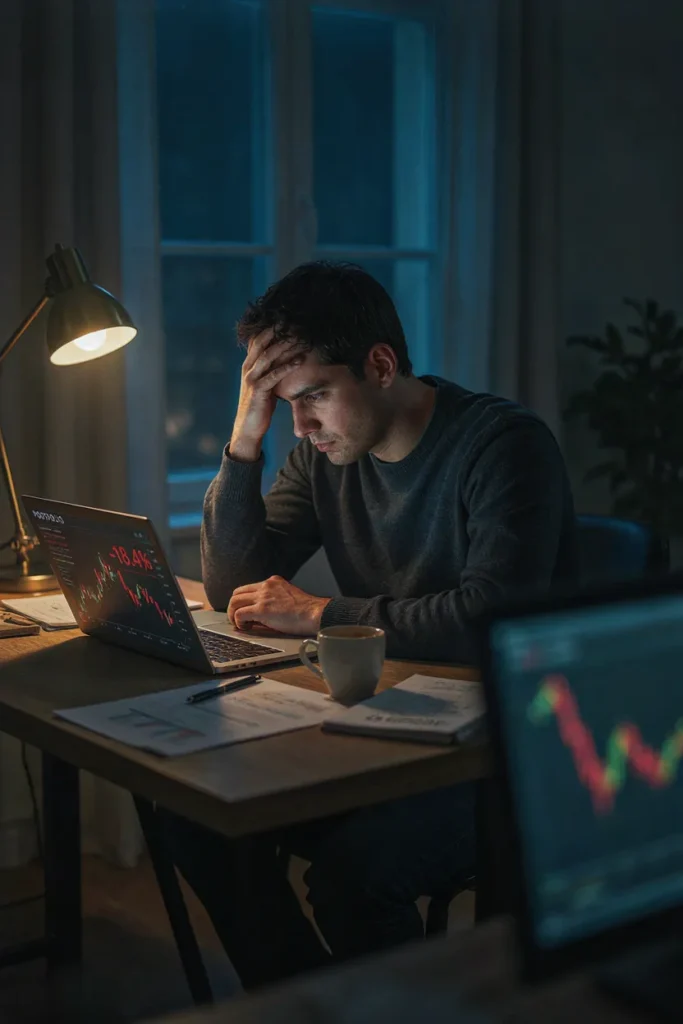
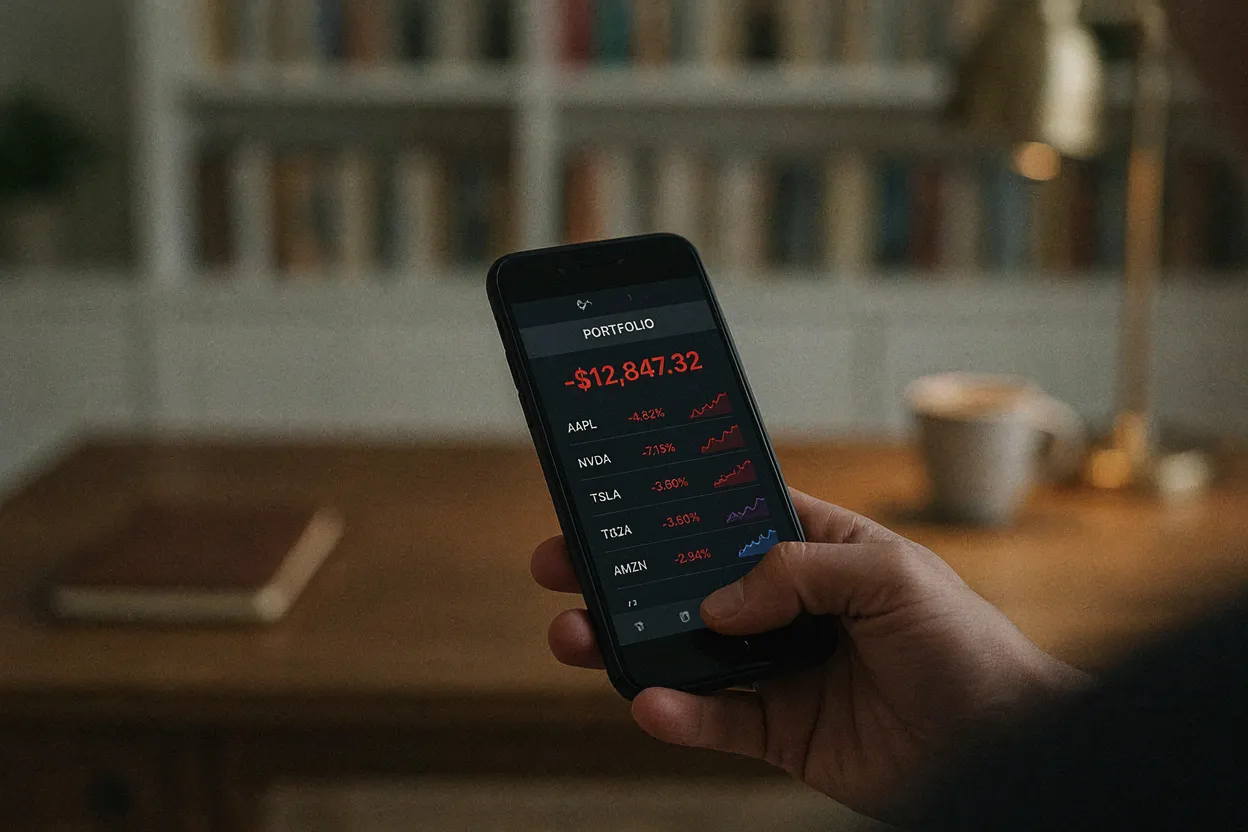
I made a bad investment in 2021. Not a spectacular one — I didn’t lose my life savings on a meme coin or anything dramatic. I just bought into a sector fund that I thought was “undervalued,” and within eight months it had dropped 30%. Every time I looked at my portfolio, there it was — a red number that reminded me I’d been wrong.
I held it for another year. Not because I had good reasons. But because selling it would have made the loss real — and as long as I held it, I could tell myself it might come back.
Investor regret is the emotional discomfort that comes from making investment decisions that didn’t work out — and it’s nearly universal. A 2022 survey by ThinkAdvisor found that 75% of investors regretted at least one investment decision that year. But the regret itself isn’t the problem. The problem is regret avoidance: the behaviors you adopt to avoid feeling the regret — holding losers too long, refusing to sell, making impulsive decisions to “make back” what you lost. The APA’s research on decision-making shows that regret is one of the most powerful drivers of future behavior — and understanding that drive is the first step toward building a system that prevents it.
What investor regret actually is (and why it’s not going away)
Investor regret is the emotional discomfort that follows a decision that didn’t work out — and it’s not a sign that you’re a bad investor. It’s a sign that you’re a human who makes decisions under uncertainty. The research from Kahneman and Tversky’s regret theory shows that people feel losses from actions they took about twice as intensely as losses from actions they didn’t take — which means most investor regret comes from things you did, not things you missed.
The 2022 ThinkAdvisor survey broke down the sources of regret clearly:
| Source of Regret | What Investors Wished | What It Reveals |
|---|---|---|
| Cryptocurrency | “I should have bought more at lower prices” | Regret of inaction — the “one that got away” |
| Stock market decline | “I should have bought the dip” | Hindsight bias — it always looks obvious after |
| Inflation | “I should have invested more to keep up” | Regret that your money lost purchasing power |
| Impulsive trades | “I shouldn’t have sold in a panic” | Regret of action — emotional decisions during volatility |
Notice something about that list. Two of the four regrets are about things you didn’t do. You didn’t buy enough crypto. You didn’t buy the dip. You didn’t invest more to beat inflation. The regret isn’t about losing money. It’s about missing an opportunity — and the research on prospect theory shows that missed opportunities feel almost as painful as actual losses, even though technically nothing was lost.
This is worth sitting with. Most investor regret isn’t about being wrong. It’s about feeling like you should have known better — even though, at the time, you made the best decision you could with the information you had.
The SEC’s investor education resources consistently emphasize that regret is a normal part of investing — and that the investors who do best over time aren’t the ones who never feel regret. They’re the ones who build systems that prevent regret from driving their next decision.
This connects directly to how loss aversion shapes financial decisions. The pain of a losing investment isn’t just the money lost — it’s the ego hit of being wrong. And that ego hit is what drives the behaviors that make things worse.

The three flavors of investor regret
Not all investor regret is the same — and each type requires a different response. Regret of action (“I bought and it dropped”), regret of inaction (“I should have bought but didn’t”), and regret of comparison (“everyone else made money on that and I didn’t”) all feel similar, but they have different causes and require different fixes.
Regret of action is the most common. You bought something. It went down. Now every time you look at it, you feel the sting of having been wrong. This is the regret that leads to holding losers too long — because selling would make the loss “real,” and as long as you hold, you can pretend it might come back.
Regret of inaction is quieter but equally corrosive. You saw an opportunity and didn’t take it. Maybe the stock went up 40% and you watched from the sidelines. Maybe you almost bought Bitcoin in 2019 and talked yourself out of it. This regret has a special bitterness to it — because it’s not about being wrong, it’s about being almost right, which feels worse.
Regret of comparison is the most toxic. It’s not about your own decisions — it’s about comparing your returns to someone else’s. Your friend made 30% on a stock you didn’t buy. Your coworker got in on crypto early. Your brother-in-law won on a speculative bet. This regret isn’t about your portfolio. It’s about your reference group — and it connects directly to how social proof drives financial decisions.
The NerdWallet guide to common investment mistakes notes that most investors make the same 3–4 errors repeatedly: buying high and selling low, chasing performance, panic-selling during downturns, and failing to diversify. These aren’t knowledge problems — they’re regret-driven behavior problems. The investor who panic-sells during a downturn isn’t ignorant. They’re trying to avoid the regret of watching their portfolio drop further.
Here’s what I’ve learned from my own bad decisions: you can’t eliminate regret. But you can categorize it — and once you know which type you’re feeling, you can respond to it instead of being driven by it.
Why you hold losers too long (the sunk cost trap)
Investors hold losing investments too long not because they have good reasons — but because selling makes the loss “real,” and the human brain will do almost anything to avoid the emotional cost of admitting a mistake. This is regret avoidance: the tendency to make decisions that protect you from regret, even when those decisions cost you money.
The 2008 housing crisis is the most visible example of this behavior at scale. Millions of homeowners found themselves owing more on their mortgages than their houses were worth. Economically, the rational move for many of them was to walk away — to stop pouring money into an asset that had lost its value. But most didn’t. They kept paying, kept hoping, kept telling themselves the market would turn around — not because the math supported it, but because walking away would have meant admitting the investment was a failure.
The Investopedia guide to regret avoidance explains this as a subset of the sunk cost fallacy — the tendency to continue investing in something because of what you’ve already put into it, rather than what it’s worth going forward. The money you spent on the house (or the stock, or the crypto) is gone regardless of what you do next. The only question that matters is: given where things are now, what’s the best use of your money from here?
For most people, that question is impossible to answer honestly — because answering it honestly often means admitting a mistake. And the brain’s aversion to that admission is stronger than its interest in financial optimization.
Here’s a framework I use. Before deciding whether to hold or sell a losing investment, I ask myself one question: If I had the cash value of this investment today, would I buy this exact same investment with it?
If the answer is yes — because the fundamentals haven’t changed, and you’d still buy it at this price — then hold. If the answer is no — because you wouldn’t buy it today, and you’re only holding because you already own it — then the regret, not the investment thesis, is driving the decision.
This connects to how emotional spending works in reverse. The same impulses that make you buy something you don’t need (the desire for instant gratification, the avoidance of discomfort) make you hold something you should sell (the avoidance of admitting a mistake, the hope that it’ll come back). The emotion is different. The structure is the same: you’re making a financial decision to avoid a feeling, rather than to optimize an outcome.
The SEC’s investor education office specifically warns about the “hold and hope” strategy — the tendency to keep losing investments based on optimism rather than analysis. Their guidance is clear: the question isn’t what you paid. The question is what the investment is worth now, and what it’s likely to be worth going forward.

The system for making better decisions next time
You can’t prevent yourself from making bad investments — but you can build a system that prevents bad investments from becoming bad decisions. The system has four parts: pre-commitment rules, the “would I buy this today?” test, automation that removes emotion from the process, and a decision journal that forces you to write down your reasoning before you act.
Pre-commitment rules are decisions you make in advance — when you’re calm and rational — about what you’ll do in specific situations. The most common one: “If any single investment drops more than 20% from my purchase price, I’ll review the thesis and either sell or write down the specific reasons I’m still holding.” This isn’t a rule that says “always sell at -20%.” It’s a rule that says “at -20%, you have to engage with the decision instead of avoiding it.” The Investopedia guide to common investing mistakes notes that most investors who suffer the worst losses don’t have bad analysis — they have no decision rules, which means every decision is made in the emotional heat of the moment.
The “would I buy this today?” test is the one I mentioned earlier. It forces you to evaluate the investment on its current merits, rather than on your attachment to the purchase price. The purchase price is irrelevant to the investment’s future. It’s relevant only to your ego — and your ego is not a reliable investment advisor.
Automation is the most powerful regret-prevention tool available. The NerdWallet guide to stock investing recommends that most investors use low-cost index funds and automated contributions — not because index funds are the “best” investment, but because they remove the decision-making that leads to regret. When you’re automatically contributing $500/month to a diversified portfolio, you don’t have to decide whether to buy or sell. You don’t have to time the market. You don’t have to feel regret about the trades you didn’t make. The system makes the decisions for you — and the decisions it makes are, over time, better than the ones most people make on their own.
A decision journal is the least glamorous but possibly the most valuable tool. Before making any investment decision, write down: what you’re buying, why you’re buying it, what would change your mind, and what you expect to happen. The APA’s research on decision-making shows that the simple act of writing down your reasoning before deciding improves decision quality — because it forces you to articulate the thesis, which makes it harder to rationalize holding on after the thesis has broken down.
I started keeping a decision journal after my 2021 mistake. Looking back at what I wrote before I bought that sector fund, the thesis was thin. I’d read one article about the sector being “undervalued” and I’d acted on it. If I’d been forced to write down my reasoning in advance, I would have seen how thin it was — and I probably wouldn’t have made the trade.
This connects to how reference dependence shapes financial satisfaction. Most investor regret — especially regret of comparison — comes from evaluating your portfolio against someone else’s returns, rather than against your own plan. The decision journal keeps you anchored to your own thesis, your own timeline, and your own definition of success.

The bigger picture
I still think about that sector fund sometimes. I eventually sold it — at a 28% loss — after writing in my decision journal that the original thesis no longer applied. It hurt. But what hurt more was the year I’d spent avoiding the decision, checking the price every day, and telling myself it would come back.
The regret of the loss was manageable. It was a specific amount of money. I could calculate it, learn from it, and move on. What was unmanageable was the year of low-grade anxiety that came from not having a system — from making the decision emotionally, in the moment, instead of having decided in advance what I’d do if things went wrong.
Here’s what I’ve taken from it, and from the research behind it:
Regret is inevitable. You will make bad investments. You will miss opportunities. You will sometimes feel like everyone else is doing better than you. That’s not a failure of investing. It’s a feature of being a human who invests.
Regret avoidance is the actual danger. The regret itself passes. What doesn’t pass is the behavior you adopt to avoid feeling it — the holding, the hiding, the refusing to look at your portfolio, the impulsive decisions to “make it back.” Those behaviors are what turn a bad investment into a bad financial life.
The fix isn’t to be smarter. It isn’t to read more or analyze better or pick the right investments. The fix is to build a system — pre-commitment rules, the “would I buy this today?” test, automation, a decision journal — that makes the right decision the default, so that when the regret comes (and it will), you already know what to do.
The investors who do best over time aren’t the ones who never feel regret. They’re the ones whose systems are strong enough that the regret doesn’t drive the next decision. And that’s a buildable skill — not a talent, not a personality trait, not something you’re born with.
It’s just a system. And systems can be built by anyone.
I’m not a financial advisor. This is what I’ve learned from reading, doing, and making mistakes. Before making investment decisions, consider talking to a fee-only fiduciary — they’re legally required to act in your best interest.
Related Reading
- Why losing $1,000 feels twice as bad as gaining $1,000 feels good
- How emotions drive financial decisions — including the ones you think are rational
- Why your reference group is quietly resetting your investment expectations
FAQ
What is investor regret?
Investor regret is the emotional discomfort that follows an investment decision that didn’t work out — and a 2022 ThinkAdvisor survey found that 75% of investors experienced it that year; the regret comes in three flavors (regret of action, inaction, and comparison), and the research from Kahneman and Tversky’s regret theory shows that people feel losses from actions they took about twice as intensely as losses from actions they didn’t take.
Why do investors hold losing investments too long?
Investors hold losers too long not because of good analysis but because selling makes the loss “real,” and regret avoidance — the tendency to protect yourself from the feeling of admitting a mistake — is stronger than the incentive to optimize your portfolio; the 2008 housing crisis showed this at scale, as millions of homeowners kept paying into underwater mortgages not because the math supported it but because walking away would have meant admitting failure.
What’s the “would I buy this today?” test?
The “would I buy this today?” test asks: if you had the current cash value of your investment, would you buy this same investment at today’s price? If yes, hold — the thesis still applies. If no, then you’re holding because of regret avoidance, not because of investment merit — and the purchase price you’re anchored to is irrelevant to the investment’s future.
How do you prevent investor regret from driving bad decisions?
The system for preventing regret-driven decisions has four parts: pre-commitment rules (decisions made in advance about what you’ll do in specific situations), the “would I buy this today?” test, automation that removes emotional decision-making from the process, and a decision journal that forces you to write down your reasoning before acting — because the SEC notes that most investors who suffer the worst losses don’t have bad analysis, they have no decision rules.
Is it better to invest emotionally or systematically?
Systematic investing consistently outperforms emotional investing over time — not because systematic investors are smarter, but because they’ve removed the decision-making that leads to regret-driven errors like panic-selling, chasing performance, and holding losers too long; NerdWallet recommends that most investors use low-cost index funds and automated contributions because they eliminate the emotional decisions that most often lead to regret.